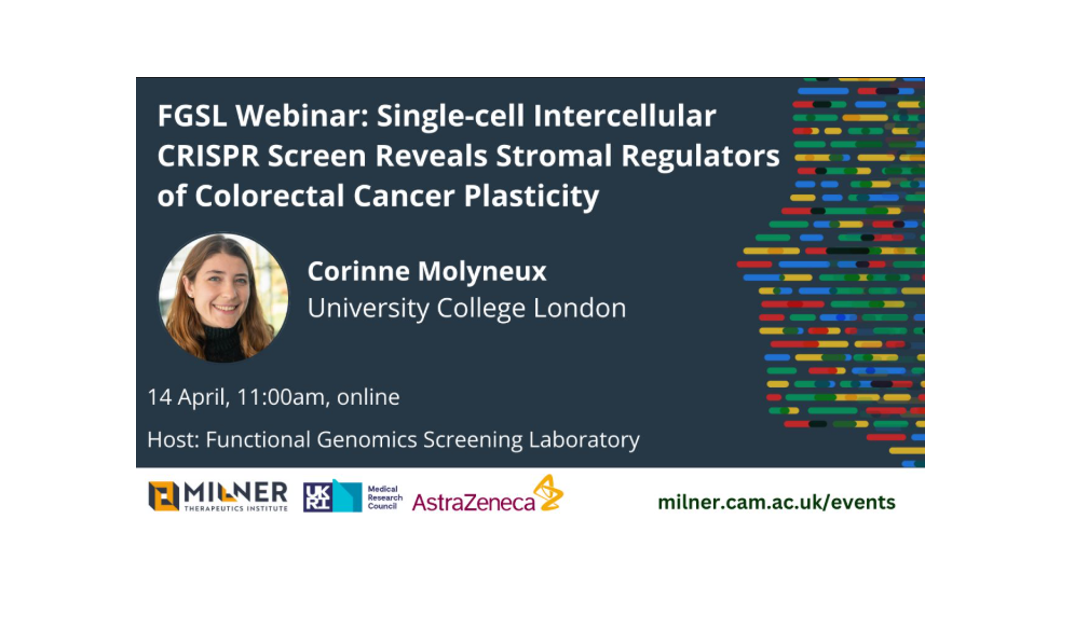
FGSL Webinar: Single-cell Intercellular CRISPR Screen Reveals Stromal Regulators of Colorectal Cancer Plasticity

Webinar
  • April 14, 2026
  • 11:00 - 13:00
  • Online
Sign up here
FGSL Webinar: Single-cell Intercellular CRISPR Screen Reveals Stromal Regulators of Colorectal Cancer Plasticity

Join the next Milner Therapeutics Institute’s Functional Genomics Screen Lab (FGSL) webinar as we welcome Corinne Molyneux, from University College London.


Abstract: Colorectal cancer (CRC) displays high levels of nongenetic phenotypic plasticity, allowing cancer cells to dynamically shift between different functions, enabling therapy evasion. This is particularly evident in poor prognosis, stromal-rich CRC tumours. These tumours also have an elevated presence of revival cancer stem cells (revCSCs). In the microenvironment of these tumours cancer-associated fibroblasts (CAFs) act as dynamic regulators driving the reversible acquisition of YAP-dependant, slow-cycling, chemoresistant features that define the revCSC state. The soluble factors that are regulating this transition were however undefined. To resolve this question, we developed a high-throughput single-cell CRISPR assay to systematically perturb the CAF secretome when in direct co-culture with patient derived organoids (PDO). Individual components of the secretome were targeted by synthetic gRNAs in Cas9 expressing CAFs before co-culture. The perturbed co-cultures were then assessed via multiplexed mass cytometry, capturing cell fate markers, post-translational modification (PTM) signalling, cell-cycle activity, and apoptosis in both PDOs and CAFs at single-cell resolution. Using this platform we have successfully targeted 202 ligands in our PDO+CAF model and quantified the role of each in the revCSC transition, unveiling the primary effector of stromal-induced CRC plasticity changes. These findings demonstrate that CRC phenotypic plasticity is regulated by stromal-derived signals, providing new mechanistic insight into therapy failure and describing a potential therapeutic intervention strategy to overcome plasticity driven chemoresistance.